We provide fintech software development services for the layer of a financial business that people see and use: the website, the CMS behind it, customer portals, partner integrations, back office tools and the data that ties them together. Clients include lending companies, trading platforms, insurtechs and regtech vendors. We do not build core banking or card processing. Those belong with vendors licensed to run them, and our job is to make everything around them work.
This page is for CTOs, product leads and heads of marketing or digital at financial companies who are comparing fintech development companies. It covers what we build, the proof behind it, and how we support your compliance and audit work.
What fintech software development covers
Most of a fintech product is ordinary web engineering. What changes is the cost of getting it wrong. A rate shown on the wrong page, a partner call that fails without anyone noticing, or a screen that confuses someone moving money all cost more in finance than in most industries.
The work falls into a few groups. There is the public site, where regulated copy changes often and needs sign-off. There are product interfaces, where several squads need to ship screens that look and behave the same. Behind those sit integrations with banks, processors, carriers and data vendors, each with its own API style and its own way of failing. And then there is the back office, where staff still read documents by hand.
We usually join one of those groups first and grow from there. Few clients hand us all of it on day one, and we do not ask them to.
Websites and content platforms
Fintech marketing sites carry more legal text than most, and it changes often. In our experience the hold-up is rarely the design. Copy gets approved in email and then sits in a queue until a developer publishes it.
For a US Series-B fintech we moved the marketing site from WordPress, with roughly 40 custom plugins, to Payload CMS and a Next.js front end. Draft, legal review and published states in the CMS now mirror the client’s sign-off process. Time to publish fell by about 65%, LCP dropped from 4.2s to 1.4s, and organic traffic held through cutover. The fintech headless CMS replatform has the details.
The website is one branch of the work, and it has its own page. Fintech website design covers page structure for financial products, regulated copy in the CMS, accessibility, speed and migration.
Product interfaces and design systems
Fintech companies grow fast, and their UI grows apart. Each squad builds its own date picker and modal, and accessibility depends on who wrote which screen.
A European Series-B fintech with eight product teams had three date picker implementations, two modal patterns and no shared color tokens. We built a component library on shadcn and Radix UI in eight weeks. Duplicated UI code fell by roughly 60%, migrated surfaces reached WCAG 2.1 AA, and a token change that used to take four to six coordinated pull requests now takes one. The shadcn library case study walks through the rollout, and our design system agency page covers the audit and build.
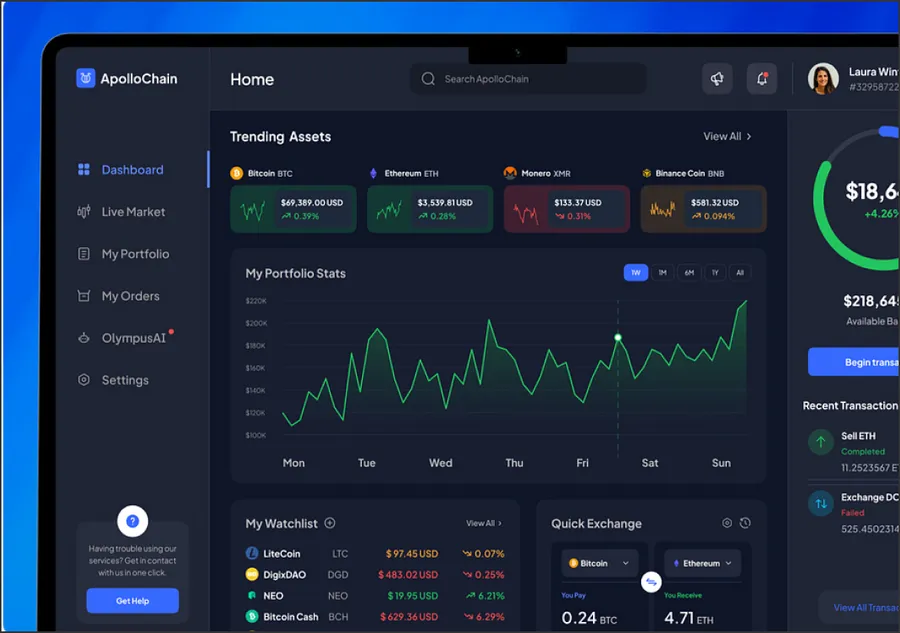
Earlier we designed a crypto trading dashboard for a fintech startup, starting from surveys and interviews and moving through prototypes and usability tests. The result put market trends, news, transactions and portfolio performance in one view. See the trading dashboard case.
APIs, integrations and back office automation
Each new partner tends to arrive with its own script and its own retry logic. After a few years nobody is sure which integration fails at night.
For a US Series-B insurtech we replaced one-off carrier integrations with a unified API platform and a connector SDK. Carrier onboarding went from about three weeks to three days, backend feature build time fell by about 60%, and integration incidents dropped by about 40%. Consistent error handling and a dead letter retry queue did most of that. The insurtech API platform case shows the design, and our backend development page covers the stack.
Back offices also run on paperwork. A US Series-B fintech with several lending products was reviewing thousands of uploaded documents a week by hand. We built an OCR pipeline that classifies bank statements, pay stubs, utility bills and tax forms, extracts the fields and sends only low confidence items to a reviewer. Manual review time fell by roughly 70%, field accuracy on the main document types is above 95%, and a document takes under ten seconds end to end. Read the document OCR case, or see our AI development services for other document and data work.
Insurance regtech as a segment
Insurance sits inside our fintech work rather than on a page of its own, because the engineering is the same: regulated content, many integrations, careful users.
Our longest running engagement in finance is with a software vendor whose product helps insurers with regulatory reporting. We rebuilt its public site on Hugo, set up a Git based CMS on Sveltia so the team can edit every language version of the site, wrote a styleguide for new pages, connected form leads to the sales tools through an API, and built a reporting dashboard from Google Analytics and Search Console data. The work is still going, which says more about it than a launch date would.
The insurtech API platform above is the other half of this segment: carriers, brokers and policy data behind one interface.
Security and audit, described as shipped work
Rules depend on what you sell and where: card data rules, KYC and AML for onboarding, privacy law for customers, and in the EU operational resilience rules for financial entities and their ICT providers. What we can show is the controls we have built for financial clients:
- Legal review states and version history for regulated copy.
- Role based access for editors, reviewers and admins, and a separate database schema per customer on a multi tenant platform.
- Human review for document fields a model is unsure about, with each decision stored.
- A retry queue that makes failed partner calls visible and replayable.
- Hosted payment fields from your processor, so card numbers stay off your servers.
- Test data in development and staging, and secrets kept outside the code.
Your compliance team decides how each rule applies. We document the architecture and data flows so they have something concrete to review. Law firms ask the same questions about confidentiality, and our software development for law firms page covers how we answer them there.
How to choose a fintech development company
Fintech development companies range from offshore firms with thousands of engineers to studios that only design. Before you pick one, ask three things. Which of your current systems will they build against, and through what API? Where will customer data sit, and who can reach it? What will you own when the project ends?
Our answers: we build against your existing vendors and published APIs, sensitive data stays in the systems contracted to hold it, and you own the code, cloud accounts and documentation from the first commit.
How engagements work
Most clients start with a short discovery to map systems, agree what is in scope and price the first release. Some hand us a whole track, such as the marketing site or the integration layer. Others add engineers to their own squads through IT staff augmentation.
If you are a SaaS company that happens to sell into finance, start with software development for SaaS companies, our overview of the product, platform and marketing site work. Healthcare teams with the same review and data questions can start with healthcare software development. For the other sectors we build for, see industries.